What is changing in Level 4 aesthetics training?
Advanced skin rejuvenation has become an important area within aesthetics. Treatments such as microneedling and chemical peels are widely used to address concerns including uneven skin texture, pigmentation, acne scarring and early signs of ageing.
Ray Cochrane previously offered Level 4 Chemical Peel and Level 4 Microneedling as standalone courses. Students could also study both treatments through the combined Level 4 Chemical Peel and Microneedling course.
We are now replacing these options with the VTCT Level 4 Certificate in Advanced Aesthetic Therapies for Skin Rejuvenation.
Chemical peels and microneedling are not being removed from our training. They remain two important practical subjects within the new qualification. The main difference is that they are now taught alongside consultation, dermatological science, ethics and professional practice as part of one broader Level 4 certificate.
The move from separate Awards to one Certificate reflects a broader qualification size, not a reduction in level. Our guide explains what Award, Certificate and Diploma mean in regulated beauty and aesthetics training.
This article explains what is changing, what remains the same and why we believe the updated course provides a stronger foundation for advanced aesthetic practice.
Understanding the previous and current Level 4 routes
The previous combined course was structured around two treatment-specific units: one in skin needling and one in skin peeling. Students completed practical and theoretical training in both treatments and received two separate VTCT Level 4 awards.
This provided a clear and focused route for practitioners who wanted regulated qualifications in chemical peels and microneedling.
The new Level 4 Certificate in Advanced Aesthetic Therapies takes a broader approach. Students still learn and are assessed in skin needling and superficial chemical peels, but the qualification also covers the knowledge needed to assess clients, plan treatments and make safe professional decisions.
Instead of receiving two separate treatment awards, students complete one regulated Level 4 certificate containing five connected units.
A simple comparison of the two routes
Here is how the previous combined course compares with the current Level 4 route:
| Feature | Previous combined course | Current Level 4 Advanced Aesthetic Therapies course |
|---|---|---|
| Availability | Being retired | Current enrolment route |
| Qualification outcome | Two separate VTCT Level 4 awards | One VTCT Level 4 certificate |
| Structure | Mainly treatment-focused | Treatments supported by consultation, skin science and professional practice |
| Treatments included | Chemical peels and microneedling | Superficial chemical peels and skin needling |
| Supporting theory | Focused on the two procedures | Includes dermatological science, consultation, ethics and professional responsibilities |
| Practical assessment | Chemical peels and microneedling | Superficial chemical peels and skin needling |
| Progression | Could support Level 5 progression | Designed to provide a foundation for suitable Level 5 progression |
The main change is not the removal of chemical peel or microneedling training. It is the addition of the supporting knowledge expected from someone working at an advanced level.
What the previous combined course offered
The combined course provided a direct route into two popular skin rejuvenation treatments.
Its structure was straightforward. Students learned how to prepare clients, perform the procedures safely and provide suitable aftercare. The course led to separate qualifications in chemical peeling and microneedling.
For learners mainly interested in adding these two treatments to their services, this focused structure was easy to understand. It concentrated on the techniques and knowledge directly connected to each procedure.
The new course retains these practical areas while placing them within a wider professional framework.
What the Level 4 Certificate includes
The Level 4 Certificate in Advanced Aesthetic Therapies includes five units:
- Principles, practices and ethical considerations for advanced aesthetic therapies
- Consultative techniques in advanced aesthetic therapies
- Dermatological science for advanced aesthetic therapies
- Provide skin needling treatments for skin rejuvenation
- Provide superficial chemical peels for skin rejuvenation
The final two units provide the practical treatment training. Students learn how to carry out skin needling and superficial chemical peels, select suitable protocols, prepare the skin and provide appropriate aftercare.
The first three units support the professional judgement behind those treatments.
Students study how to complete more detailed consultations, identify contraindications, understand relevant skin conditions, manage client expectations and recognise the limits of their professional role.
This means that the course is not only about learning how to perform a procedure. It also develops the knowledge needed to decide whether a procedure is appropriate for a particular client.
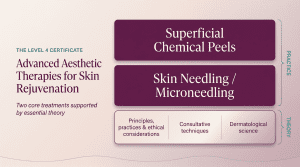
The Level 4 Certificate combines two practical treatment units with three supporting theory units covering consultation, dermatological science and professional responsibilities.
What remains the same
Microneedling and superficial chemical peels remain central parts of the training.
Students continue to receive supervised practical experience and are assessed on their ability to perform both procedures safely. They must demonstrate suitable hygiene, client care, communication, treatment technique and aftercare.
The new course is still a regulated Level 4 qualification. It can also support progression to the VTCT Level 5 Certificate in Non-surgical Aesthetic Procedures for Skin Rejuvenation, provided the relevant entry requirements are met.
What changes is the context in which the treatments are taught. Chemical peels and microneedling are now connected to a wider understanding of skin science, consultation and professional responsibility.
Why we are replacing the previous courses
We are replacing the standalone and combined courses because we believe advanced treatment skills should be supported by a broader clinical and professional foundation.
Knowing how to perform a chemical peel or microneedling treatment is important. However, safe practice also depends on the decisions made before the treatment begins.
A practitioner needs to understand the client’s medical and treatment history, assess the condition of the skin, identify contraindications and decide whether the requested procedure is suitable. They also need to explain realistic outcomes, provide appropriate aftercare and recognise when a client should not be treated.
The additional units in the Level 4 Certificate address these responsibilities directly.
Combining practical treatment training with dermatological science, consultation and professional ethics creates a more connected learning experience. Students can understand not only how a treatment works, but why a particular protocol may or may not be suitable for an individual client.
The change also creates a clearer qualification route. Rather than choosing between separate chemical peel, microneedling or combined qualifications, new students can complete one comprehensive Level 4 course covering both treatments and the supporting knowledge.
This does not mean that the previous training lacked value. It reflects how we have chosen to structure our future Level 4 delivery and the standard of preparation we want students to have before progressing further in aesthetics.
Can I still study only chemical peels or microneedling?
We will no longer offer the regulated Level 4 Chemical Peel and Level 4 Microneedling qualifications as standalone enrolment options.
Students wishing to train in these procedures through our regulated Level 4 route will study them as part of the Level 4 Certificate in Advanced Aesthetic Therapies.
This means that you will be trained and assessed in both skin needling and superficial chemical peels, together with consultation, dermatological science and professional practice.
The qualification is awarded as one Level 4 certificate rather than separate qualifications for each treatment.
Who is the new course suitable for?
The Level 4 Certificate is intended for learners who already hold an accepted Level 3 qualification.
This may include a suitable Level 3 Beauty Therapy qualification containing the required anatomy and physiology content, or the Level 3 Certificate in Access to Aesthetic Therapies.
Admissions may need to review your qualification certificate and unit transcript before confirming eligibility. Two qualifications at the same level can contain different units, so the qualification title alone may not establish whether you meet the entry requirements.
The course may suit you if you:
- Want regulated training in chemical peels and microneedling
- Want to move from facial treatments into advanced skin rejuvenation
- Prefer a qualification that combines practical skills with consultation and skin science
- Intend to progress to suitable Level 5 aesthetics training
- Want a more complete understanding of treatment planning and client suitability
If you are uncertain whether your current qualification is accepted, book a course consultation before enrolling.
Final thoughts
The retirement of the standalone Chemical Peel, Microneedling and Combined Chemical Peel and Microneedling courses does not mean these treatments are disappearing from our Level 4 training.
Both treatments remain important parts of the new Level 4 Certificate in Advanced Aesthetic Therapies. The difference is that they are now taught within a wider qualification that also covers consultation, dermatological science, professional responsibilities and ethical practice.
We believe this gives students a more complete foundation for working safely in advanced skin rejuvenation and for progressing to higher-level aesthetics qualifications.
If your goal is to gain regulated Level 4 training in chemical peels and microneedling, the Level 4 Certificate in Advanced Aesthetic Therapies is now the course to consider.
View the Level 4 Certificate in Advanced Aesthetic Therapies
Frequently asked questions
Are chemical peels and microneedling still included in the Level 4 course?
Yes. Superficial chemical peels and skin needling are two of the five units included in the Level 4 Certificate in Advanced Aesthetic Therapies.
Can I book the Level 4 Chemical Peel course separately?
No. The standalone regulated Level 4 Chemical Peel course is being retired. Chemical peel training will be available as part of the broader Level 4 Certificate.
Can I book the Level 4 Microneedling course separately?
No. The standalone regulated Level 4 Microneedling course is also being retired. Skin needling is included and assessed within the Level 4 Certificate.
What is happening to the combined Chemical Peel and Microneedling course?
The combined course is being replaced by the Level 4 Certificate in Advanced Aesthetic Therapies. The new course still covers both treatments but adds consultation, dermatological science, ethics and professional practice.
Will I receive separate qualifications for chemical peels and microneedling?
No. Students completing the new route receive one VTCT Level 4 Certificate in Advanced Aesthetic Therapies for Skin Rejuvenation. Skin needling and superficial chemical peels are assessed units within that certificate.
Does the Level 4 Certificate support progression to Level 5?
Yes. The qualification can support progression to suitable Level 5 aesthetics training, subject to the entry requirements of the Level 5 course.
What qualification do I need before joining?
Applicants normally need an accepted Level 3 Beauty Therapy qualification containing suitable anatomy and physiology units, or a Level 3 Certificate in Access to Aesthetic Therapies. Admissions should check other qualifications individually.