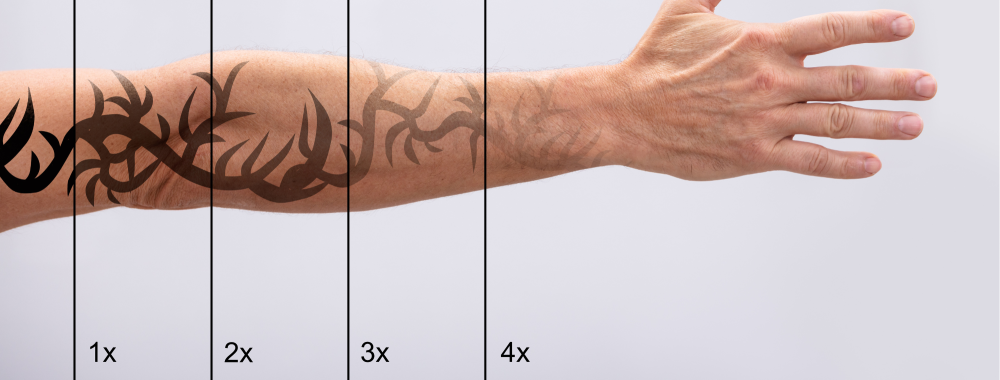
If you are interested in becoming a laser tattoo removal technician, your starting point will depend on the qualifications you already have. You may be completely new to beauty and aesthetics, already hold a Level 2 or Level 3 beauty qualification, or be working as a Level 4 laser practitioner.
Whichever stage you are at, the aim is the same: to gain the specialist Level 5 qualification required for laser tattoo removal and meet the professional requirements for working safely and legally.
If you already hold an accepted Level 4 Laser and IPL qualification, you may be able to progress directly to Level 5 Laser Tattoo Removal training. If you are a beginner, you will first need a suitable Level 3 foundation, followed by Level 4 Laser and IPL.
For most non-medical practitioners, the progression route is:
- Complete an accepted Level 3 foundation.
- Complete a regulated Level 4 Laser and IPL qualification.
- Complete a regulated Level 5 Laser Tattoo Removal qualification.
- Complete Core of Knowledge and training for the specific laser, where required.
- Arrange suitable insurance and work from correctly licensed premises.
This guide will help you identify your starting point, understand which qualifications you need and choose between a focused tattoo removal pathway and a broader route into laser and aesthetic treatments.
What does a laser tattoo removal technician do?
As a laser tattoo removal technician, you will use specialist laser equipment to fade or remove unwanted tattoo pigment. Most clients need a course of treatments rather than one session, so you will often work with the same person over several months.
Your work begins before you operate the laser. You will review the client’s medical history, medication, skin, tattoo colours, tattoo location and previous treatment. You must be able to identify contraindications, explain what the treatment can realistically achieve and decide whether it is safe to proceed.
The role can include:
- completing consultations and treatment records
- assessing the tattoo and the client’s skin
- carrying out patch tests where required
- selecting settings within an approved treatment protocol
- operating Q-switched laser systems
- monitoring the skin during and after treatment
- providing aftercare
- recording progress and treatment parameters
- recognising reactions that require referral or a change of plan
This combination of technical treatment and long-term client care is what makes the role more involved than simply learning how to operate a machine. You must understand the laser you use, follow the clinic’s local rules and remain within the treatments covered by your training and insurance.
What qualifications are required to perform laser tattoo removal in London?
If your goal is to perform laser tattoo removal in London, Level 5 is the treatment-specific qualification you need.
This distinction appears in London council guidance. The London Borough of Bexley states that Level 5 training is required for tattoo removal. The Royal Borough of Greenwich also states that laser tattoo removal requires Level 5 training. Greenwich separately says that authorised laser and IPL users should have at least Level 4 laser training and a Core of Knowledge certificate.
It helps to separate three questions that are often mixed together:
| Question | Relevant requirement |
|---|---|
| What qualification covers laser tattoo removal? | A regulated Level 5 Laser Tattoo Removal qualification |
| What do I need to enrol on Ray Cochrane’s Level 5 course? | An accepted Level 4 qualification in Laser Hair Removal |
| What do I need before treating clients? | The relevant qualifications plus council licensing compliance, equipment training, insurance and any required Core of Knowledge training |
Level 4 Laser and IPL does not qualify you to perform tattoo removal. It gives you the laser foundation and, for the current Ray Cochrane Level 5 course, it is the entry qualification.
Once you gain Level 5, you still need to complete the professional checks that apply to your workplace. The certificate does not issue your premises licence or arrange your insurance.
Course entry requirements and professional requirements are different
You may see Level 3, Level 4 and Level 5 listed together and assume that they are all parts of one legal rule. They are not. Each level has a different purpose in the training route.
At Ray Cochrane, the VTCT Level 5 Laser Tattoo Removal course is designed for practitioners who already hold a Level 4 qualification in Laser Hair Removal. If you do not yet hold Level 4 laser training, you need to complete that stage before applying for this Level 5 course.
To enter the Level 4 Laser and IPL course, you will normally need an accepted beauty-related Level 3 qualification or a medical qualification. If you hold Anatomy and Physiology rather than a broader beauty or aesthetics qualification, ask admissions to review your certificate and unit transcript before you book.
When your training is complete, you must also meet the requirements of the council, insurer, employer and premises. They assess different parts of your professional practice, so they may not all request the same evidence.
Which training route applies to you?
If you are a complete beginner and want the most focused route
If you want to focus mainly on laser treatments, you may be able to begin with a suitable Level 3 Anatomy and Physiology qualification. You would then progress to Level 4 Laser and IPL and finally Level 5 Laser Tattoo Removal.
The route is:
Level 3 Anatomy and Physiology, subject to admissions approval
Level 4 Laser and IPL
Level 5 Laser Tattoo Removal
Level 3 Anatomy and Physiology gives you the scientific foundation for later study. It does not qualify you to perform laser treatments. Before choosing this route, ask the Level 4 course provider to confirm that your qualification will be accepted. You should also ask your intended insurer whether it will accept the completed Level 3, Level 4 and Level 5 portfolio.
This is the more focused laser pathway. It can take you towards tattoo removal without requiring you to train in the wider range of treatments covered by Beauty Therapy. The trade-off is that it gives you a narrower foundation for other beauty and aesthetics work.
If you are a complete beginner and want a broader aesthetics route
If you want tattoo removal to form part of a wider career in aesthetics, consider a broader Level 3 foundation.
The route can be:
Level 3 Access to Aesthetic Therapies
Level 4 Laser and IPL
Level 5 Laser Tattoo Removal
You could also choose a combined pathway that includes Level 3 Access to Aesthetic Therapies and Level 3 Facial Electrotherapy. You will study skin, facial treatments, consultation and electrical facial practice before progressing into laser.
This Level 3 training does not permit you to perform tattoo removal. It gives you a broader understanding of skin and client care and can support progression into other aesthetics qualifications, subject to their entry requirements.
If you hold a Level 2 facial or beauty qualification
A Level 2 facial or beauty qualification gives you a useful start, but it is normally below the entry level for regulated Level 4 laser training.
Your next step is to complete an accepted Level 3 qualification. Depending on your career goal, this may be:
- Level 3 Beauty Therapy
- Level 3 Access to Aesthetic Therapies
- Level 3 Anatomy and Physiology, where accepted by admissions
- a combined Level 3 aesthetics and facial electrical route
Once you have completed an accepted Level 3 qualification, you can progress to Level 4 Laser and IPL and then Level 5 Laser Tattoo Removal.
If you already hold Level 3 Beauty Therapy or Level 3 Access to Aesthetics
You may already be ready to apply for Level 4 Laser and IPL. Ask admissions to confirm that your qualification contains the required units. Two certificates at the same level can cover different subjects, so the title alone may not be enough.
Once you have completed an accepted Level 4 laser qualification, you can apply for Level 5 Laser Tattoo Removal.
If you already hold Level 4 Laser and IPL
You are already at the final progression point before specialist tattoo removal training. If your Level 4 certificate meets the entry requirement, you can apply for the VTCT Level 5 Laser Tattoo Removal course.
If your course title or awarding body differs from the current entry wording, send admissions your certificate and unit transcript before booking.
If you want to work in a beauty clinic, spa or medical spa
If you want to work across several departments in a beauty clinic, spa or medical spa, the shortest laser pathway may be too narrow for your plans.
One possible progression is:
Level 2 Facial or Beauty Therapy
Level 3 Beauty Therapy
Level 4 Laser and IPL
Level 5 Laser Tattoo Removal
Level 3 Beauty Therapy gives you a wider base for work involving facial and body treatments. Level 4 then adds laser hair removal and IPL skin rejuvenation within the qualification’s scope. Level 5 adds tattoo removal.
This route takes longer, but it can prepare you for a wider choice of roles. Employers set their own requirements, and a medical spa may ask for particular beauty, medical or treatment qualifications depending on the services you will provide.
What does Level 4 Laser and IPL add?
At Level 4, you move from your general beauty or aesthetics foundation into professional laser and IPL treatments. Ray Cochrane’s Level 4 qualification covers hair removal and skin rejuvenation, together with consultation, skin and hair assessment, contraindications, health and safety and practical treatment delivery.
The skin rejuvenation unit covers concerns such as pigmentation, sun damage, acne and signs of ageing within the scope of the qualification and equipment used.
Once qualified and appropriately insured, you may be able to build a broader laser service portfolio that includes:
- laser or IPL hair removal
- IPL skin rejuvenation treatments covered by the qualification
- progression to Level 5 Laser Tattoo Removal
Many laser platforms have more than one application. A device may have different handpieces, wavelengths or treatment modes. Seeing an option on the machine does not mean you are qualified to use it. Each treatment must be covered by your qualification, equipment training, insurance, council approval and clinic protocol.
For example, a Q-switched system used for tattoo removal may also have applications for treating skin pigmentation. Your Level 5 tattoo removal certificate does not automatically cover every pigmentation or skin-brightening treatment the device can technically deliver.
What does Level 5 Laser Tattoo Removal add?
Level 5 is where you specialise in tattoo removal. Ray Cochrane’s current course covers:
- principles and practice of non-medical aesthetic therapies
- advanced consultation
- advanced skin care
- removing or fading tattoos using Q-switched laser systems
- practical and external assessment
This is the qualification that adds tattoo removal to your treatment scope. Your Level 4 certificate alone does not do that.
You will also develop more advanced consultation and treatment-planning skills. Tattoo ink, skin type, tattoo depth, colour and previous treatment can all affect the response. You need to know when to proceed, when to adjust the plan and when not to treat.
Do you need a special treatment licence in London?
If you plan to work in London, your qualification is only part of the preparation. Laser tattoo removal is a licensable special treatment, and the business or premises must meet the requirements of the council responsible for its location.
The London Borough of Bexley states that cosmetic laser procedures, including tattoo removal, require a special treatment licence when provided from premises in the borough. Greenwich has its own laser and IPL licence conditions.
When you or your employer applies, the council may request:
- regulated qualification certificates
- unit transcripts
- Core of Knowledge evidence
- training for the specific machine
- insurance
- Laser Protection Adviser documentation
- local rules and treatment protocols
- equipment servicing and safety records
- details of authorised users
Requirements are not identical across every London borough. Contact the council before choosing premises, buying equipment or advertising treatments. If you join an existing clinic, ask to see that its licence covers laser tattoo removal and confirm that you are included as an authorised practitioner where required.
Do you need Core of Knowledge and machine training?
Your treatment qualification teaches you how to carry out laser tattoo removal. Core of Knowledge has a different purpose: it covers the safe use of laser and intense pulsed light equipment. Bexley says this training must be provided by a certified Laser Protection Adviser and refreshed every five years. Greenwich also refers to Core of Knowledge for authorised laser and IPL users.
You also need training on the specific machine used in practice. The controls, wavelengths, pulse characteristics, maintenance requirements and approved treatment uses vary between systems.
These forms of training serve different purposes:
| Training | What it demonstrates |
|---|---|
| Level 5 Laser Tattoo Removal | Treatment-specific competence in laser tattoo removal |
| Core of Knowledge | General laser and IPL safety knowledge |
| Manufacturer or equipment training | Competence with the controls and operation of a particular system |
Machine training cannot replace your regulated Level 5 treatment qualification. Equally, completing Level 5 does not mean that you can operate an unfamiliar laser without learning how that particular system works.
What insurance is required?
Before you treat paying clients, make sure your policy explicitly covers laser tattoo removal, the device you use and your working arrangement.
An insurer will normally want to see your Level 5 tattoo removal qualification and machine training. It may also ask for Level 4 laser training, a Level 3 foundation, Core of Knowledge, council licensing information or unit transcripts.
There is no single Level 3 portfolio accepted by every insurer. One insurer may accept Anatomy and Physiology as part of a complete Level 3, Level 4 and Level 5 progression. Another may expect a broader Level 3 beauty or aesthetics qualification.
Ask the insurer in writing before committing to a training route or buying equipment. Give them the exact qualification titles, awarding bodies and units, along with the treatment, device and workplace you plan to use.
Focused tattoo removal route or broader laser therapist route?
You can reach Level 5 through a focused laser route or a broader beauty and aesthetics route. The better choice depends on what you want your working week to look like after you qualify.
| Career aim | Suggested foundation | Later progression |
|---|---|---|
| Focus mainly on laser tattoo removal | Accepted Level 3 foundation, potentially Anatomy and Physiology subject to approval | Level 4 Laser and IPL, then Level 5 Tattoo Removal |
| Offer tattoo removal, laser hair removal and IPL skin rejuvenation | Level 3 Access to Aesthetics or another accepted beauty-related Level 3 | Level 4 Laser and IPL, then Level 5 Tattoo Removal |
| Build a wider beauty, facial and laser career | Level 2 where needed, followed by Level 3 Beauty Therapy or a combined facial and aesthetics route | Level 4 Laser and IPL, then Level 5 Tattoo Removal |
| Already qualified in laser hair removal | Accepted Level 4 Laser and IPL | Level 5 Tattoo Removal |
If you want to spend most of your time performing laser treatments, the focused route may make sense. If you want to offer facials, beauty treatments or other aesthetics procedures as well, the broader route is likely to give you more useful options. In either case, confirm your planned progression with admissions and a suitable insurer.
Step-by-step guide to entering the profession
1. Decide what you want to offer
Picture the role you want after qualifying. Do you want to specialise in tattoo removal, or would you also like to provide laser hair removal, skin rejuvenation, facial or beauty treatments? This decision will help you choose the right Level 3 foundation.
2. Have your existing qualifications assessed
Send your certificates and unit transcripts to admissions before booking. This is especially important if your qualification has a different title, awarding body or unit combination.
3. Complete any missing Level 3 foundation
If you are a complete beginner or hold Level 2, complete an accepted Level 3 route before Level 4 laser training. Choose between a focused scientific foundation and a broader beauty or aesthetics pathway.
4. Complete Level 4 Laser and IPL
At Level 4, you will learn laser and IPL principles and practical treatments for hair removal and skin rejuvenation. This qualification also provides the entry route to Ray Cochrane’s Level 5 tattoo removal course.
5. Complete Level 5 Laser Tattoo Removal
Complete regulated training that includes supervised practical work, consultation, treatment planning and formal assessment.
6. Check the borough’s licensing conditions
Decide where you plan to work and contact the relevant London council. Check its treatment, premises and authorised-user requirements before you begin setting up.
7. Complete Core of Knowledge and machine training
Use a Core of Knowledge provider and renewal schedule accepted by the council. Complete training for the exact laser you will operate.
8. Obtain written insurance confirmation
Ask the insurer to confirm in writing that your policy covers laser tattoo removal, your machine, the premises and your employment or self-employed arrangement.
9. Work within your treatment scope
Follow the clinic’s local rules and treatment protocols. Keep consultation, patch-test, treatment and aftercare records. Stay within the treatments covered by your training, even if the machine offers additional settings.
Frequently asked questions
What qualifications do I need to perform laser tattoo removal in London?
Level 5 Laser Tattoo Removal is the treatment-specific qualification. In the London council guidance reviewed for this guide, laser users are also expected to have suitable general laser training, Core of Knowledge and equipment-specific training. You must also meet the licensing and insurance requirements for your workplace.
Do I need both Level 4 and Level 5?
They serve different purposes. Level 5 covers tattoo removal. Level 4 provides the laser foundation and is the current entry requirement for Ray Cochrane’s Level 5 course. If you do not yet hold an accepted Level 4 laser qualification, complete that before applying for Level 5.
Can I enrol on Level 5 Laser Tattoo Removal without Level 4?
Not on Ray Cochrane’s current VTCT Level 5 course. Applicants must hold a Level 4 qualification in Laser Hair Removal.
Can a complete beginner become a laser tattoo removal technician?
Yes, but a complete beginner cannot move straight to Ray Cochrane’s Level 5 course. The usual progression is an accepted Level 3 foundation, Level 4 Laser and IPL, and Level 5 Laser Tattoo Removal.
Is Level 3 Anatomy and Physiology enough to start the route?
It may be accepted as a foundation for Level 4, but this must be checked with admissions. It does not qualify you to perform laser treatments. Ask an insurer to review the intended complete qualification portfolio as well.
Do I need Level 3 Beauty Therapy?
You do not have to follow the full Beauty Therapy route. Level 3 Beauty Therapy is useful if you want a broader beauty, facial or spa career. Level 3 Access to Aesthetic Therapies may suit you if you want to focus on non-medical aesthetics. A more focused Anatomy and Physiology route may be considered for laser progression, subject to admissions and insurance checks.
Can I perform tattoo removal with Level 4 Laser and IPL?
No. Level 4 covers laser hair removal and skin rejuvenation within its qualification scope. Tattoo removal requires the specialist Level 5 qualification.
Does Level 5 qualify me for laser hair removal and skin rejuvenation too?
Level 5 Tattoo Removal adds tattoo fading and removal. Your eligibility to provide laser hair removal or IPL skin rejuvenation comes from the relevant Level 4 units and must also be covered by your equipment training, insurance and licensing.
Do I need a special treatment licence?
Laser tattoo removal is a licensable special treatment in London. The premises must meet the conditions of the relevant borough. If you work in an existing clinic, confirm that the licence covers tattoo removal and that your practitioner details are included where required.
Do I need manufacturer training if I have Level 5?
Yes, where required by the council, insurer or clinic. The qualification teaches the treatment. Equipment training covers the operation of the particular laser system.
Does the certificate automatically allow me to start treating clients?
No. Before treating clients, confirm licensing, insurance, Core of Knowledge, machine training, local rules and treatment protocols. A qualification demonstrates assessed competence, but it does not replace these professional requirements.
Your next step
If you already hold Level 4 Laser and IPL, you may be closer to qualifying than you think. Ask admissions whether your certificate meets the entry requirement for the VTCT Level 5 Laser Tattoo Removal course.
If you are beginning at Level 2, Level 3 or with no previous beauty qualifications, you can still work towards this career. Start by asking admissions to assess your current qualifications and the treatments you eventually want to offer. Send your certificate and unit transcript if you have them, as the qualification title alone may not show everything you studied.