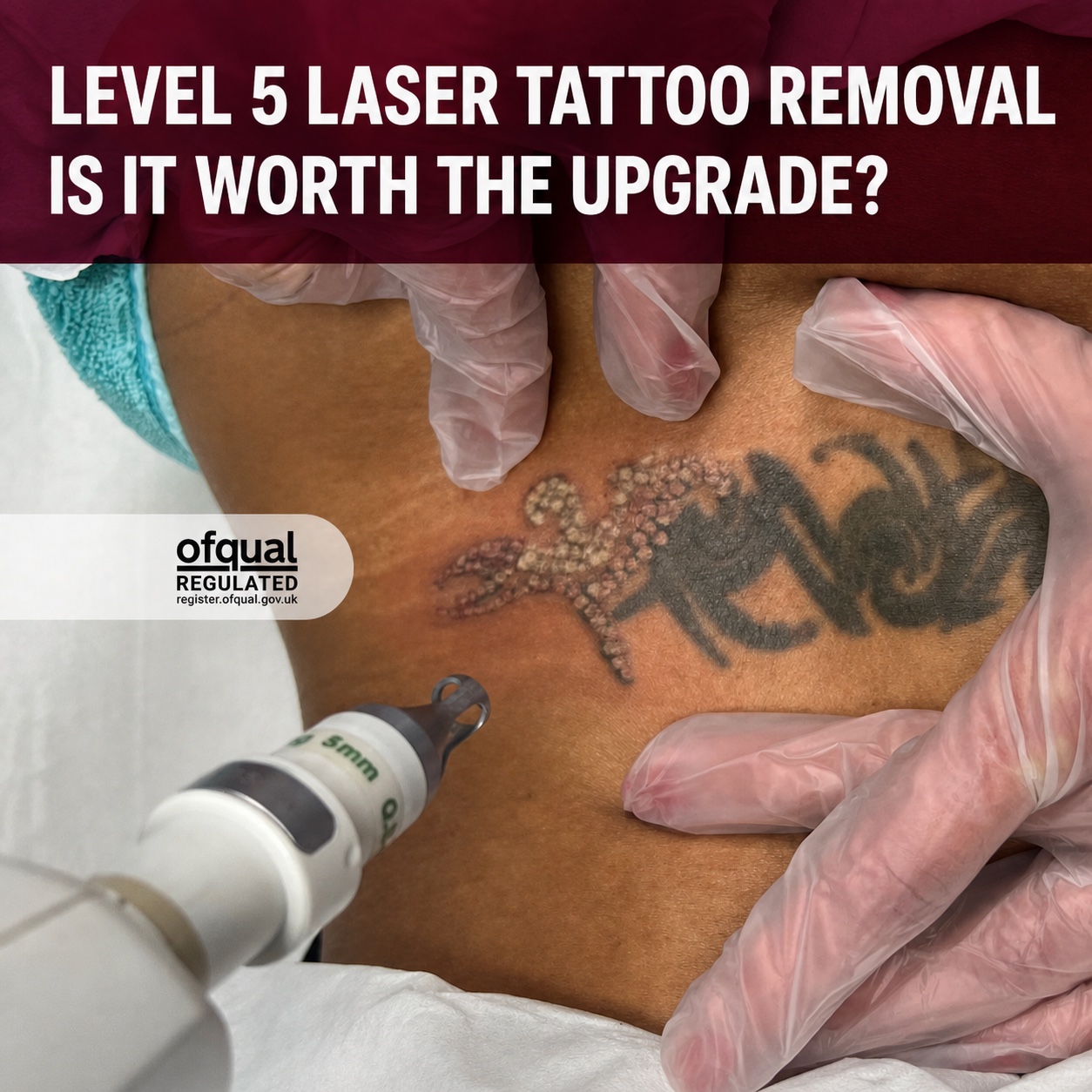
Two machines can both be called lasers and still demand very different thinking from the practitioner. In hair removal, you are using controlled heat to affect a hair follicle. In tattoo removal, you are delivering extremely short pulses to break pigment into smaller particles. That change from a mainly photothermal effect to a predominantly photoacoustic one is why Level 5 is a genuine clinical progression, not simply another certificate.
I have worked with several laser platforms over many years, across both hair removal and tattoo removal, and I developed Ray Cochrane’s Level 4 Laser and IPL and Level 5 Laser Tattoo Removal courses. One question comes up repeatedly when I speak to qualified laser therapists: “I already have Level 4. Is Level 5 really worth it?”
It is a sensible question. Finishing Level 4 is a major achievement. You can assess clients, work with laser and light systems, perform hair-reduction treatments and, where your qualification includes it, provide IPL skin rejuvenation. Level 5 opens another clinical area, but I do not believe every therapist should rush into it simply because it is the next number.
Tattoo removal can become a rewarding specialist service, but it asks more of the practitioner. The target is different, the tissue response is different and the treatment journey can be long and unpredictable. In this guide, I will explain what changes at Level 5, what I look for in a practitioner who is ready to progress and when I would advise someone to wait.
The short answer
My short answer is yes, Level 5 can be worth it, but only when the timing and business case are right. I would seriously consider progressing if you:
- want to offer tattoo fading or removal professionally;
- enjoy the technical and clinical side of laser practice;
- have access to suitable Q-switched laser equipment;
- can meet insurance, premises and local licensing requirements;
- have evidence of demand from your existing or intended clients; and
- are prepared to manage treatments that can require a long series of appointments.
I would advise waiting if you are still building confidence at Level 4, have no realistic access to suitable equipment or have not investigated the full cost of adding tattoo removal to your business.
Think of Level 5 as a specialist progression, not an automatic upgrade that every Level 4 therapist needs.
Why Level 4 comes before Level 5
When I developed the course pathway at Ray Cochrane, it was important that Level 5 built on a proper laser foundation. That is why an accepted Level 4 qualification in Laser Hair Removal or Laser and IPL is a mandatory entry requirement. A complete beginner cannot enrol directly.
Level 4 develops the habits and knowledge that safe laser practice depends on, including:
- client consultation and informed consent;
- Fitzpatrick skin typing and skin assessment;
- contraindications and contra-actions;
- wavelengths, fluence and pulse duration;
- patch testing and treatment planning;
- controlled-area procedures and protective eyewear;
- record keeping, aftercare and treatment review; and
- the ability to observe and respond to the skin during treatment.
I expect Level 5 learners to arrive with these skills already established. We then apply that foundation to a more specialised treatment.
Competence in laser hair removal does not automatically make someone competent in tattoo removal. You are no longer assessing hair as the target. You must learn to read tattoo pigment, understand how different colours may respond and recognise when treatment could be unpredictable or unsafe.
The science changes at Level 5: photothermal versus photoacoustic effects
This is the distinction I most want therapists to understand. Laser hair removal and laser tattoo removal both use light energy, but they do not rely on exactly the same tissue interaction.
Laser hair removal is primarily photothermal
In laser hair removal, melanin in the hair absorbs light energy and converts it into heat. We use that heat to create controlled thermal damage in the follicular structures responsible for hair growth while limiting injury to the surrounding skin. This is the principle of selective photothermolysis.
Hair-removal systems generally use pulse durations measured in milliseconds. The therapist must balance wavelength, fluence, pulse duration, spot size and cooling against the client’s skin type and the hair’s colour, depth and thickness. Hair growth stage also matters, which is one reason a course of treatments is normally required.
When I teach this part of Level 4, I ask learners to keep one clinical question in mind: how can sufficient heat reach the intended follicular target without causing unacceptable damage to the epidermis?
Tattoo removal relies much more heavily on a photoacoustic effect
Tattoo removal has a different target: pigment particles held within the skin.
Q-switched and picosecond lasers deliver energy in extremely short pulses. The rapid absorption of that energy causes fast thermal expansion and pressure waves within the pigment. This predominantly photoacoustic or photomechanical effect helps fracture larger pigment particles into smaller fragments, which the body can gradually process and clear.
I sometimes hear this simplified to “hair removal is heat and tattoo removal is sound”. That is useful as a memory aid, but it is not the complete physics. Tattoo removal still produces heat. The important distinction is the dominant clinical mechanism: hair removal uses controlled thermal injury to affect the follicle, while tattoo removal uses very short laser pulses to create a predominantly photoacoustic effect within tattoo pigment.
| Clinical principle | Laser hair removal at Level 4 | Laser tattoo removal at Level 5 |
|---|---|---|
| Main target | Melanin associated with the hair follicle | Tattoo pigment particles in the skin |
| Dominant effect | Photothermal | Predominantly photoacoustic or photomechanical |
| Typical pulse scale | Milliseconds | Nanoseconds or picoseconds, depending on the system |
| Treatment objective | Thermally impair structures responsible for hair growth | Fragment pigment so it can be cleared gradually |
| Important variables | Skin type, hair colour, depth, density and growth stage | Tattoo colour, pigment composition, depth, density and tattoo type |
| Course planning | Influenced by the hair-growth cycle | Influenced by pigment response, clearance and tissue recovery |
This difference is why Level 5 involves much more than learning the controls of another machine. You are learning to make a new set of treatment decisions.
What additional competence does Level 5 develop?
The regulated VTCT Skills (ITEC) Level 5 Certificate in Laser Tattoo Removal includes four units:
- Principles and practice of non-medical aesthetic therapies
- Advanced consultation for non-medical aesthetic therapies
- Advanced skin care for non-medical aesthetic therapies
- Removing or fading tattoos using Q-switched laser systems
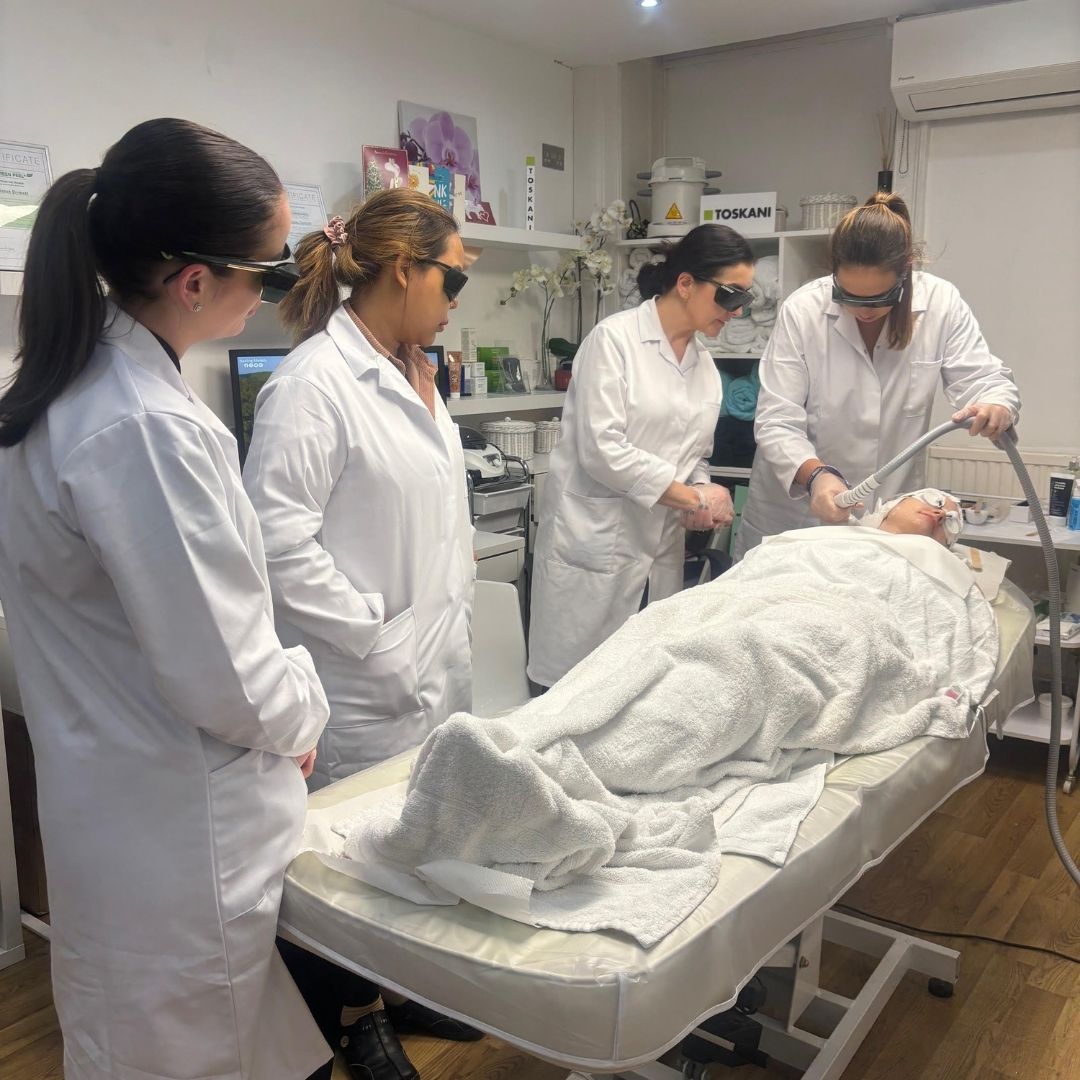
At Ray Cochrane, I designed the learner journey to build on the existing Level 4 foundation. The current course combines online theory with five consecutive academy days. Learners cover client assessment, treatment planning, safety and aftercare before bringing that knowledge into supervised practical work with Q-switched laser systems. Assessment includes theory work, assignments or case studies, practical assessment and an external examination.
Operating a different laser is only one part of the training. Much of the real work lies in learning how to make decisions about tattoos and pigment, including:
- identifying professional, amateur, cosmetic and traumatic tattoos;
- assessing pigment colours, density, depth and layering;
- matching wavelength choice to the pigment being targeted;
- recognising when a tattoo may respond unpredictably;
- understanding the risk of pigmentary change and scarring;
- recognising possible paradoxical darkening of some cosmetic pigments;
- identifying an appropriate immediate treatment endpoint;
- planning realistic intervals between sessions;
- explaining that complete clearance cannot be promised; and
- knowing when treatment should be postponed, declined or referred.
These decisions affect safety and results. Just as importantly, they determine whether a client begins treatment with realistic expectations.
An indirect benefit: a stronger foundation for other pigment treatments
There is another benefit that is easy to overlook. Training with a Q-switched tattoo-removal laser gives you a deeper understanding of short-pulse laser technology and how light interacts with pigment. That knowledge can make future training on other pigment-focused treatments easier to understand.
At first, a tattoo and a pigmented skin lesion may seem like completely different targets. A tattoo contains exogenous pigment, which has been introduced into the skin. A freckle, lentigo or another benign pigmented lesion involves endogenous pigment, usually melanin produced within the skin. They are not assessed or treated in the same way, but both require the practitioner to understand wavelength selection, pigment absorption, pulse duration, treatment endpoints and the risk of unwanted pigmentary change.
Some Q-switched and picosecond laser platforms have separate protocols or manufacturer indications for selected benign pigmented lesions. Research has also examined these technologies for concerns such as lentigines, freckles and certain dermal pigment conditions. Carbon-assisted laser treatments, often called a carbon laser peel, may also use a Q-switched 1064 nm Nd:YAG laser with a topical carbon suspension.
I see this as a foundation for further learning, not permission to add those treatments immediately. A Level 5 Laser Tattoo Removal qualification assesses competence in tattoo fading and removal. It does not automatically qualify you to diagnose or treat pigmented lesions, offer a carbon peel or use every function available on a multi-application platform.
Before offering any additional treatment, you would still need appropriate treatment-specific and manufacturer training, insurance approval and confirmation that the procedure is permitted within your premises and local licensing arrangements. Pigmented lesions also require particularly careful assessment. A suspicious or uncertain lesion should not be treated cosmetically and may need medical referral.
Even with those boundaries, the indirect benefit is real. Once you understand Q-switched laser physics, pigment targeting and photoacoustic effects, later device-specific training has more context. You are building a broader laser education rather than learning each machine setting in isolation.
Does tattoo removal offer a worthwhile business opportunity?
Potentially, yes. My advice is to judge the opportunity against your own clinic rather than a headline about industry growth.
Tattoo removal is usually delivered as a treatment course rather than a single appointment. Clients may want complete removal, partial fading before a cover-up or treatment of a particular colour. This can create repeat business, but the number of sessions varies widely.
In one large prospective cohort using Q-switched lasers, successful removal was reported for 47.2% of patients after ten sessions and 74.8% after fifteen sessions. Outcomes were influenced by factors including tattoo colour, pigment density, location and smoking. These figures should not be used as a promise to clients; they demonstrate why consultation and individual treatment planning matter.
Before assuming that Level 5 will increase your income, I would ask:
- How many current clients have asked about tattoo fading or removal?
- Are local tattoo artists looking for a trusted practitioner to fade work before cover-ups?
- What do established providers in your area charge, and how busy are they?
- Will the service complement your existing clinic identity?
- Can your premises accommodate a laser controlled area?
- Will you buy, lease or work from a clinic that already owns suitable equipment?
- How long would it take to recover the total investment at a realistic appointment volume?
A sound business case depends on local demand and operating costs. A qualification gives you competence and credibility, but it does not create a market by itself.
The qualification fee is only part of the investment
The Level 5 course is one cost. Becoming operational may involve several others:
- access to an appropriate Q-switched or picosecond laser;
- manufacturer training for the equipment you will use;
- servicing, maintenance and safety checks;
- treatment-room preparation and protective eyewear;
- professional treatment insurance;
- support from a Laser Protection Adviser where required;
- local rules and risk assessments;
- premises licensing or registration requirements;
- clinical documentation and consent systems; and
- marketing, photography and client-acquisition costs.
Requirements vary by insurer and local authority. For example, Westminster City Council states that premises offering special treatments may require a licence and asks laser applicants to provide local rules agreed with a Laser Safety Adviser. I always tell practitioners to check the rules for the borough or authority where they will actually work. Do not assume that another clinic’s arrangements will apply to you.
None of this makes progression unattractive. It simply needs to be part of your financial planning from the beginning.
When is Level 5 likely to be worth it?
In my experience, progression is more likely to make sense when several of the following apply:
You already feel confident with Level 4 laser practice
You are comfortable conducting consultations, recognising contraindications, documenting patch tests, following controlled-area procedures and making safe treatment decisions. You are ready to build on that foundation rather than still trying to establish it.
Clients are already asking for tattoo removal
Existing demand reduces the risk of investing in a service that does not suit your market. Record genuine enquiries for several months instead of relying on memory.
You have a realistic equipment plan
You know which system you are likely to use, how you will access it, what its servicing costs are and whether your insurer will cover it. Qualification training and manufacturer-specific training serve different purposes; you may need both.
You want a more specialised laser career
Tattoo removal may appeal if you enjoy laser physics, careful assessment, long-term client journeys and technically demanding treatment planning.
You can meet the operational requirements
You have investigated insurance, local licensing, safety documentation and premises requirements before enrolling, rather than treating them as an afterthought.
When might it be better to wait?
I would consider waiting if:
- you have only recently qualified at Level 4 and need more supervised or workplace experience;
- you do not yet have access to suitable equipment;
- your insurer or premises cannot currently support the treatment;
- there is little evidence of demand in your client base;
- the investment would place too much pressure on your business; or
- you are more interested in developing IPL skin rejuvenation or consolidating hair-removal skills first.
Waiting is not the same as abandoning the progression route. Six or twelve months spent strengthening your consultations, building a laser client base and researching equipment can make you a much stronger Level 5 learner later.
A practical readiness check
| Question | Ready now | Needs investigation |
|---|---|---|
| Do I hold an accepted Level 4 Laser Hair Removal or Laser and IPL qualification? | ||
| Am I confident with laser consultation, patch testing and safety procedures? | ||
| Have clients or referral partners demonstrated genuine demand? | ||
| Do I know which Q-switched or picosecond system I would use? | ||
| Have I priced equipment access, servicing and consumables? | ||
| Has an insurer confirmed what it would require to cover me? | ||
| Have I checked the rules for my local authority and premises? | ||
| Do I understand the additional risks and treatment variability? | ||
| Can I explain why tattoo removal fits my clinic and career plan? |
If most of your answers sit in the second column, Level 5 may be a logical next step. If several sit in “needs investigation”, I would complete that research before committing.
The progression route through Ray Cochrane
For a practitioner who already holds an eligible Level 4 qualification, the next regulated step is the VTCT (ITEC) Level 5 Laser Tattoo Removal Course.
If you have not yet reached Level 4, the usual pathway is:
- Complete a relevant Level 3 beauty, skin or aesthetics qualification.
- Progress to the VTCT Level 4 Laser Hair Removal and IPL Course.
- Build the required foundation in laser consultation, safety and treatment practice.
- Progress to Level 5 Laser Tattoo Removal when you are ready.
Applicants with a Level 4 certificate under a different title should send their certificate and unit transcript to admissions for an eligibility check before booking.
My view: is Level 5 Laser Tattoo Removal worth it?
Yes, it can be. I believe Level 5 is a strong progression for an established Level 4 therapist who wants to specialise, has evidence of client demand and understands the equipment and compliance costs.
The value does not come from having a certificate with a higher number on it. It comes from learning a treatment with different laser-tissue interactions, more complex pigment assessment and longer treatment planning.
Level 4 gives you an essential laser foundation. Level 5 teaches you how to apply and extend that foundation to a different chromophore, a different treatment endpoint and a different set of client risks.
Before enrolling, confirm that your Level 4 qualification is accepted. Then look honestly at local demand and calculate the full cost of becoming operational. If the figures work and the treatment suits the direction of your clinic, Level 5 may be a sensible investment in your laser career.
About Eleonora Androva
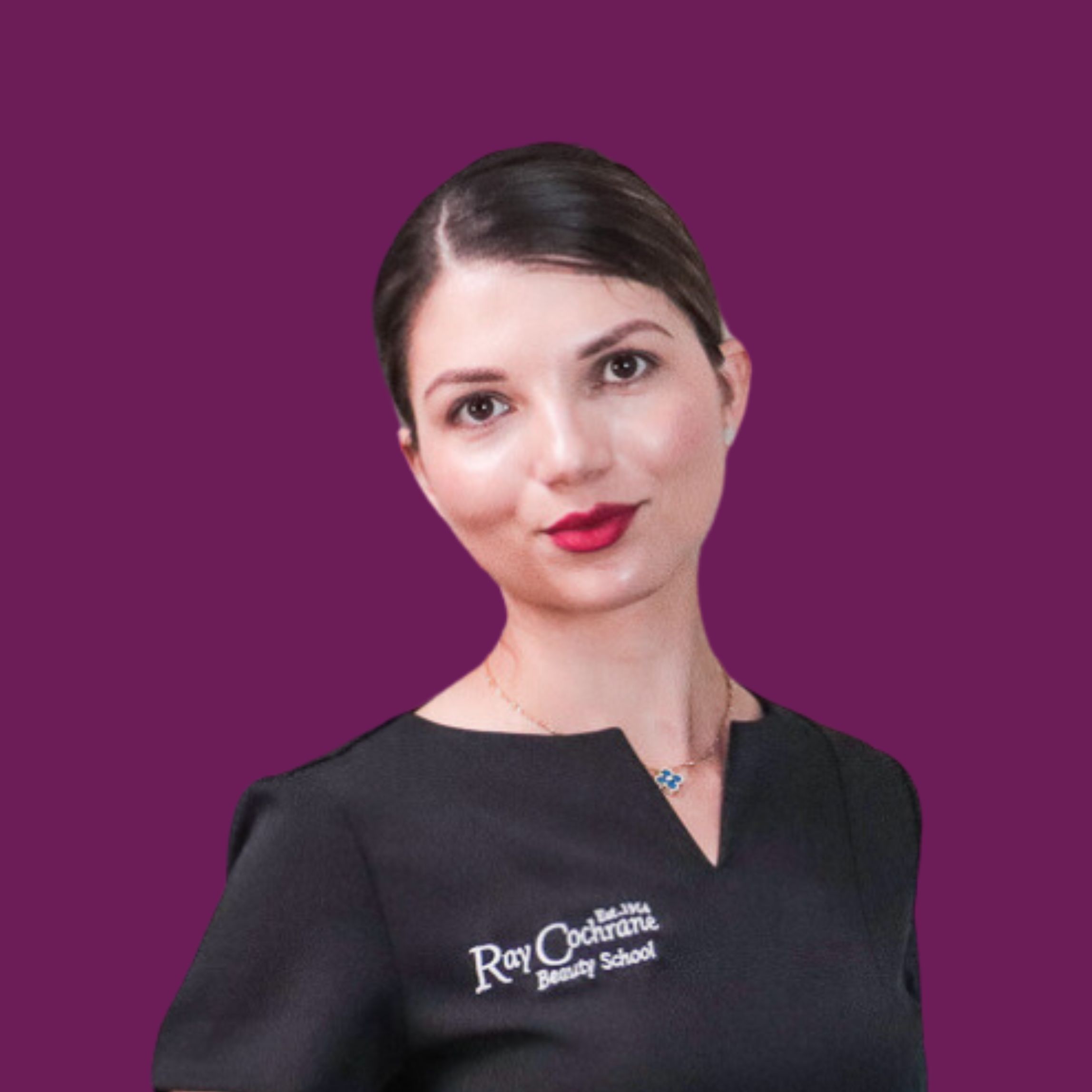
Eleonora Androva is a laser educator at Ray Cochrane Beauty Aesthetics Academy. She developed the academy’s Level 4 Laser and IPL and Level 5 Laser Tattoo Removal courses and has many years of practical experience across multiple laser platforms used for hair removal and tattoo removal.
Frequently asked questions
Do I need Level 4 Laser and IPL before Level 5 Laser Tattoo Removal?
For Ray Cochrane’s Level 5 course, yes. Applicants must hold an accepted Level 4 qualification in Laser Hair Removal or Laser and IPL. If the title or units differ, admissions should review the certificate before enrolment.
Is laser tattoo removal included in a Level 4 hair-removal course?
No. Level 4 Laser and IPL training covers its specified hair-removal and skin-rejuvenation units. Laser tattoo removal is a separate specialist treatment requiring additional Level 5 study.
Are laser hair removal and tattoo removal based on the same science?
They share core laser principles, but the dominant treatment effects differ. Hair removal is primarily photothermal and targets melanin associated with the follicle. Q-switched or picosecond tattoo removal uses extremely short pulses to create a predominantly photoacoustic effect that fragments pigment.
Does Level 5 automatically allow me to open a tattoo-removal clinic?
No. The qualification demonstrates assessed knowledge and competence, but you must also arrange appropriate insurance, equipment access, manufacturer training where required, safety documentation and compliance with the rules applying to your premises and local authority.
Can a Level 5 therapist guarantee complete tattoo removal?
No. Response varies with tattoo colour, pigment composition, density, depth, location, skin type, treatment history and individual factors. Ethical consultation should explain uncertainty and avoid guaranteeing complete clearance or a fixed number of sessions.
How is the Ray Cochrane Level 5 course delivered?
The current course combines online theory with five consecutive academy days in London. Learners complete practical training and the required assessments and examinations. Always check the live course page for current dates, fees and availability.