Course levels make sense once you work with qualifications every day. If you are new to aesthetics, Level 3, Level 4 and Level 5 can look like three versions of the same course, each one a little more advanced than the last.
That is not quite how the pathway works.
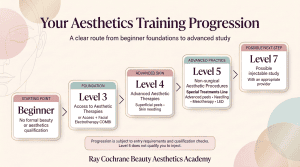
Level 3 gives beginners the knowledge needed before advanced treatment training. Level 4 introduces superficial chemical peels and skin needling. Level 5 is for practitioners who already have suitable Level 4 training and want to work with more advanced procedures.
The course you can join depends on what you already hold, not simply how ambitious you are or how much experience you have. Your qualification title and the units on your certificate matter too.
This page compares the three levels so that you can see where you may fit. If you want a broader explanation of the career itself, including different training routes, read our guide to becoming a qualified non-medical aesthetician.
A quick comparison of the three levels
Swipe left across the table to compare all four columns.
| Course | Usually suits | Main areas of study | Typical next step |
|---|---|---|---|
| Level 3 Access to Aesthetic Therapies | Complete beginners and people changing career | Facial skincare, skin analysis, anatomy and physiology, pathology, electrical science, consultation and safety | Level 4 aesthetics training |
| Level 3 Access and Facial Electrotherapy COMBI | Beginners who want a wider practical start | The Access syllabus plus facial electrical treatments and experience with professional machines | Level 4 training or Level 3 facial practice |
| Level 4 Advanced Aesthetic Therapies | Learners with an accepted Level 3 qualification | Dermatological science, advanced consultation, superficial chemical peels and skin needling | Level 5 non-surgical aesthetics |
| Level 5 Non-surgical Aesthetic Procedures | Practitioners with an accepted Level 4 qualification | Advanced peels and needling, needle mesotherapy, LED, assessment and complication management | More advanced non-surgical practice and possible Level 7 progression |
A level number never tells the full story. Two Level 4 certificates may contain different treatment units, so Admissions may need to see your certificate and unit transcript.
Not sure which level accepts your current qualification?
Send our Admissions team your certificate, unit transcript and the course you would like to study. We can check your starting point before you enrol.
Level 3 is the starting point for most beginners
Someone entering aesthetics without a beauty qualification will usually begin with the VTCT Level 3 Certificate in Access to Aesthetic Therapies.
The qualification was designed as a route into Level 4 aesthetics. You do not normally need to complete a separate Level 2 Facial course first. Instead, the programme brings together the subjects you need before studying more advanced skin treatments:
- facial skincare and skin analysis
- anatomy, physiology and pathology
- electrical science
- consultation, client care and record keeping
- health, safety, treatment planning and aftercare
Students are often most excited about chemical peels, microneedling or mesotherapy. We understand why. Still, a practitioner needs to recognise contraindications, assess the skin and know when a client should not be treated. Level 3 is where that judgement starts to develop.
It is also where the commercial pathway begins. A student can progress from Level 3 Access to Level 4 Advanced Aesthetic Therapies and later to Level 5 Non-surgical Aesthetic Procedures, provided the entry requirements are met at each stage.
Access or the COMBI course?
Ray Cochrane offers two beginner routes, and the difference is mainly the amount of practical facial training included.
The standard Level 3 Access course is the more focused route. It gives you the recognised academic and practical foundation for Level 4 progression without adding a separate facial electrotherapy qualification.
The Level 3 Access and Facial Electrotherapy COMBI combines the Access qualification with the VTCT Level 3 Award in Facial Electrotherapy. You also train with equipment used for galvanic treatments, high frequency, microcurrent, EMS and lymphatic drainage.
We tend to recommend the COMBI to beginners who want more time working with facial equipment before they move into advanced aesthetics. It can help if you plan to work in a facial or skin clinic, or if you simply know that confidence comes through practice for you.
The standard Access course is still a proper route to Level 4. Choosing the COMBI does not make the Access qualification more valid. It adds another qualification and a wider set of practical skills.
There is one point that causes confusion. The standalone Level 3 Facial Electrotherapy course normally requires a relevant earlier qualification, such as Level 2 Facial, Level 3 Access or an accepted Level 2 Beauty Therapy course. The COMBI is open to beginners because it packages Access and Facial Electrotherapy into one planned route.
Level 4 introduces advanced skin treatments
The VTCT Level 4 Certificate in Advanced Aesthetic Therapies for Skin Rejuvenation is where learners move into superficial chemical peels and skin needling.
The course also covers dermatological science, advanced consultation, professional practice and aftercare. You need to assess whether a procedure is appropriate for the person sitting in front of you, select a safe protocol and explain the risks clearly.
Applicants normally need to be at least 18 and hold either the Level 3 Certificate in Access to Aesthetic Therapies or an accepted Level 3 Beauty Therapy qualification that includes the required anatomy and physiology content. You also need enough written and spoken English for theory work, assessments, consultations and treatment records.
A medical background, overseas certificate or years of salon experience may be relevant, but Admissions will still need to check the formal content of your training. Experience does not always replace missing regulated units. We would rather review your paperwork before enrolment than recommend a course you are not ready to join.
Once qualified, you may be able to offer the treatments in which you were trained and assessed. Insurance, local licensing and workplace rules still apply. Level 4 can also lead to Level 5.
Level 5 assumes that Level 4 is already in place
The VTCT Level 5 Certificate in Non-surgical Aesthetic Procedures for Skin Rejuvenation is not a beginner course. It is intended for practitioners who already hold suitable Level 4 training.
The programme includes advanced chemical peels, advanced skin needling, needle mesotherapy for skin rejuvenation and hair restoration, LED phototherapy, detailed client assessment and complication management.
There is more responsibility at this level. You are expected to connect a client’s medical history and skin condition with treatment depth, product choice, contraindications and possible complications. You must also know when to refer.
Entry normally requires an Ofqual-regulated Level 4 aesthetics qualification with the relevant skin rejuvenation content. If your Level 4 followed a different route, Admissions may ask for the unit breakdown, treatment certificates and evidence of experience. The team will also confirm any emergency response or additional safety evidence required for the intake.
This qualification can support a later application to a Level 7 injectable course, but Level 5 does not qualify someone to inject. Level 7 providers set their own entry rules. Injectable practice also has separate legal, prescribing, insurance and professional requirements.
Can you miss out one of the levels?
Some applicants can begin at Level 4 because they already hold an accepted Level 3 Beauty Therapy qualification with suitable anatomy and physiology. A complete beginner would normally need Level 3 Access first.
The same test applies at Level 5. You need an accepted Level 4 qualification with the right theory and treatment units. Holding a certificate marked “Level 4” does not automatically make it suitable, and practical experience may not cover a gap in the regulated syllabus.
If you are unsure, send Admissions your certificate, unit transcript and the name of the course you want to join. That gives the team something concrete to assess.
Which route fits your situation?
If you have no formal beauty or aesthetics qualification, Level 3 Access will usually be your starting point. Choose the COMBI version if you want a broader practical foundation and dedicated facial electrotherapy training.
If you already have an accepted Level 3 qualification and want to learn superficial peels and skin needling, Level 4 is likely to be the relevant course.
Level 5 is for someone who has completed suitable Level 4 training and wants to progress into advanced peels, needling, mesotherapy, LED and more detailed complication planning.
There is no advantage in applying for the highest number if your earlier training does not meet the entry requirements. The sensible choice is the course that follows on from what you have already studied and leads towards the treatments you want to offer.
View this post on Instagram
Frequently asked questions
Is Level 3 Access to Aesthetics suitable for a complete beginner?
Yes. It was developed for learners who do not have a formal beauty therapy background. You will still need to meet the academy’s normal age, English language and enrolment requirements.
Do I need Level 2 Facial before Level 3 Access?
No. Level 3 Access includes facial skincare alongside Level 3 anatomy, physiology and electrical science. A separate Level 2 Facial qualification is not normally required.
Is every Level 3 qualification accepted for Level 4 aesthetics?
No. The qualification content matters. Level 3 Access was designed to support progression to Level 4, and an appropriate Level 3 Beauty Therapy qualification may also be accepted. Admissions should review other certificates individually.
What is the difference between Level 4 and Level 5 aesthetics?
Level 4 introduces superficial chemical peels and skin needling, supported by advanced skin science and consultation. Level 5 builds on that training with advanced protocols, needle mesotherapy, LED and more detailed work on assessment and complications.
Do I need to be a nurse or doctor?
No. These courses provide a regulated pathway for non-medical students. If you have a medical or healthcare qualification, Admissions will check whether its units meet the entry requirements for the course you want to study.
Does Level 5 qualify me to perform injectables?
No. It may support an application to a suitable Level 7 injectable qualification, but it does not give you an injectable qualification by itself.
Ask us to check your starting point
Send the Admissions team your existing certificates, your unit transcript if you have one, and a short note about the treatments you hope to offer. The team can confirm whether you should begin with Level 3 Access, the COMBI route, Level 4 or Level 5, and explain any gaps before you enrol.
That check is especially important if your qualification came from another awarding body, another country or a course with a similar title but different units.